A complete translation accompanied by a signed certification statement from the translator or translation company.
Certified vs sworn translation
What is the difference between a certified and sworn translation?
Both are official translations, but they solve different acceptance problems. A certified translation is usually what U.S. agencies, courts, schools, and immigration offices request. A sworn translation is usually needed when a foreign authority requires an officially appointed translator.
- USCIS, NVC and court-ready certified translations
- Sworn translators for Spain, France, Germany, Italy, Brazil and more
- Secure upload, digital delivery and optional notarization
A translation completed by an official translator authorized under the rules of a specific country, court, ministry, or public body.
Ask where the document will be submitted and what exact wording the authority uses in its instructions.
Definitions
Certified and sworn translations are not interchangeable terms.
The confusion is understandable. In everyday speech, people use words like certified, official, legal, notarized, accredited, and sworn as if they mean the same thing. In document acceptance, those words can point to very different requirements.
What is a certified translation?
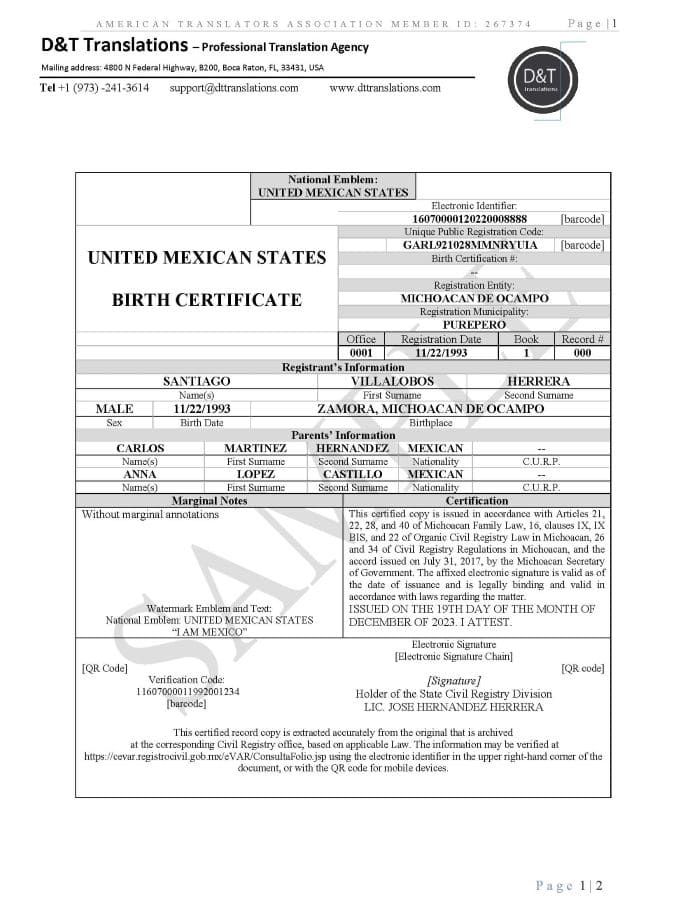
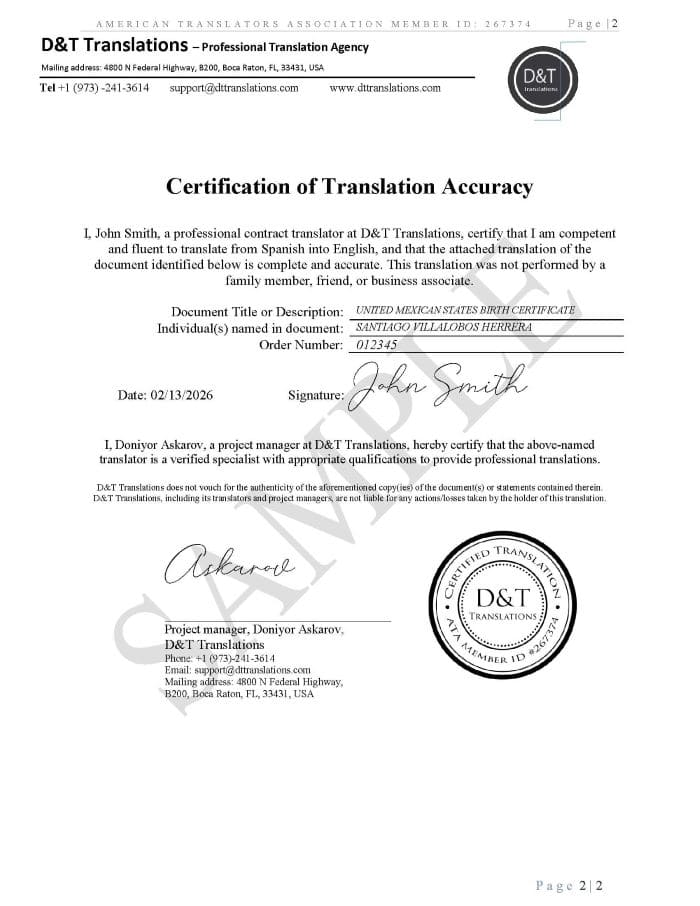
A certified translation is a translation that includes a signed statement confirming that the translation is complete and accurate and that the translator or translation company is competent to translate the source document.
In the United States, this is the standard format requested by many official bodies because there is generally no single federal roster of "sworn translators" for all document translations. The certification statement provides the receiving office with a clear professional attestation.
- Usually accepted for USCIS, NVC, immigration courts, universities, employers, licensing boards, banks, DMVs and many U.S. courts.
- Typically delivered as a print-ready PDF with the translation, certification statement, company details, date and signature.
- May include optional notarization, shipping, apostille support or credential evaluation when the receiving party asks for those additional services.
- Best for most documents submitted inside the United States, including birth certificates, marriage certificates, diplomas, transcripts, police certificates, contracts and court records.
What is a sworn translation?
A sworn translation is prepared by a translator who has been formally authorized, appointed, registered or sworn by a government body, court, ministry, chamber of commerce, professional college or similar authority. The title and procedure vary by country.
Sworn translators are common in Europe, Latin America and other civil law jurisdictions. Their seal, signature or official registration gives the translation the form required by that destination country. D&T Translations works with sworn, official and court-accredited translators from many countries for international submissions.
- Often required by foreign civil registries, courts, ministries, embassies, consulates, universities, tax authorities and immigration offices outside the United States.
- Rates and turnaround times are usually higher because the pool of authorized translators is smaller and the country rules are stricter.
- The translator may need to apply an official seal, include a registration number, follow a prescribed format or submit a sworn declaration.
- Best when the instructions use terms such as sworn translator, official translator, court-certified translator, ministry-certified translator or authorized translator.
Side by side
Certified vs sworn translation comparison table
Use this table as a practical starting point. The receiving authority always has the final say, so the safest approach is to match its exact written requirement.
| Question | Certified translation | Sworn translation |
|---|---|---|
| Who prepares it? | A qualified translator or translation company that certifies the completeness and accuracy of the translation. | A translator officially authorized under the law or administrative rules of the destination country. |
| What gives it official value? | The signed certification statement, translator or company identification, date, contact details and attestation of accuracy. | The translator's official appointment, registration, seal, stamp, title, signature or sworn status in the relevant jurisdiction. |
| Typical use | USCIS, NVC, EOIR immigration court, U.S. colleges, credential evaluation, licensing boards, employers, banks, DMVs and many U.S. legal matters. | Foreign courts, consulates, embassies, civil registries, ministries, universities, notaries and government offices that require an authorized translator. |
| Common documents | Birth, marriage, divorce and death certificates; diplomas; transcripts; police certificates; bank statements; contracts; affidavits; medical and immigration records. | Civil status documents, court judgments, powers of attorney, academic records, corporate filings, public deeds, tax documents and records for use abroad. |
| Delivery format | Usually a signed PDF, with optional physical copy, notarization or shipping. | Depends on the country. Some authorities accept a scanned sworn translation; others require an original, stamp, seal, paper format or additional legalization. |
| Cost and timing | Usually faster and more affordable. D&T certified translations can often be completed in 24 to 48 hours, with rush options when available. | Usually higher and slower because only authorized translators for the exact country, language pair and document type can complete the work. |
| Notarization | Optional add-on when requested. The notary verifies the signer or sworn statement, not the linguistic accuracy itself. | May or may not be part of the local process. Some countries use a sworn translator's stamp alone; others may require a notary, apostille, legalization or chamber seal. |
| Acceptance risk | Low when the receiving party asks for a certified translation and the document includes a complete signed certification. | Low when the sworn translator is authorized for the destination country and follows that country's formal requirements. |
Decision helper
Which type of translation should you order?
Start with the receiving authority, not the source document. The same birth certificate might need a certified translation for USCIS, a sworn translation for Spain, and an apostille on the original document for a separate international filing.
Use cases
Common situations and the safer choice
These are the patterns D&T Translations sees most often when clients are comparing certified and sworn translation services.
US
Immigration to the United States
For USCIS, NVC and immigration court, a certified English translation is usually the correct format. The translation should be complete, accurate and accompanied by a signed statement from the translator or translation company.
ED
School, licensing or employment in the U.S.
Universities, credential evaluators, employers and licensing boards often request certified translations of diplomas, transcripts, certificates, syllabi and professional records. Some boards may have extra formatting rules.
INT
Documents for use abroad
If your document will be submitted to a foreign ministry, court, civil registry, embassy or consulate, a sworn translation may be required. The requirement depends on the destination country and the specific authority.
CT
U.S. court or legal matter
Many U.S. legal settings accept certified translations, especially when the translation is accompanied by a declaration. Some proceedings may require a court-certified interpreter, expert affidavit, notarization or local court format.
NT
Notarized translation request
Notarized does not automatically mean sworn. A notarized translation typically means the certification statement or affidavit is signed before a notary. The notary does not make the translation official in a foreign sworn-translator system.
AP
Apostille or legalization request
An apostille authenticates the origin of a public document or notarized signature for international use. It is separate from translation. D&T certified translations can be notarized and apostilled when a receiving authority requires that. Sworn translations normally do not need D&T apostille handling because the sworn translator's seal, signature or official authorization is usually the acceptance mechanism.
Country examples
Where sworn or official translators are commonly required
The exact title changes by country. D&T Translations can help identify whether the receiving authority needs a sworn translator, a certified translation, a notarized certification, an apostille or another official format.
What D&T includes
Upload documents for
review
Built for acceptance, not just word-for-word conversion.
D&T certified translations are prepared for official review. A typical certified translation includes the translated document, a signed certification statement, company contact information, a date, and delivery as a high-quality PDF through email and your account.
For sworn projects, D&T routes the work to an appropriate sworn, official or court-accredited translator for the destination country whenever that level of authorization is required.
Transparent quote
Upload a scan or photo, select the service type and receive pricing guidance
quickly.
Human translators
Projects are handled by qualified professionals with the right language and
document experience.
Optional add-ons
Digital or physical notarization, shipping, apostille support and credential
evaluation are available when needed.
Revision support
You can review the translation and request corrections before finalizing
additional services.
Ordering process
How to avoid ordering the wrong service
The best way to prevent delays is to gather the requirement before ordering. If you do not have it, D&T can still help you make a practical choice based on the destination and document type.
Read the receiving authority's instructions
Look for exact phrases such as "certified English translation," "notarized translation," "sworn translator," "official translator," "court-appointed translator," or "apostille." Those words matter.
Identify the destination country and agency
A translation for USCIS is different from a translation for a Spanish civil registry or a French court. The destination authority controls the format.
Upload a clear scan or photo
For most documents, a smartphone photo is enough to begin the quote. Complex layouts, handwriting, rare languages and urgent deadlines can affect final pricing.
Choose certified, sworn or ask for guidance
If you know the authority needs a sworn translator, select sworn translation. If the requirement is unclear, include the agency instructions in your order notes so the team can review them.
Review, approve and request add-ons if needed
You receive the translation digitally. If the receiving party asks for a notary, physical copy, apostille, mailing, or credential evaluation, those can be handled as additional services where available. Apostille support usually applies to certified translations or notarized certification documents rather than sworn translations.
FAQ
Certified vs sworn translation questions
These answers cover the questions clients usually ask before placing an official document translation order.
Is a sworn translation more official than a certified translation?
Not always. It depends on who is receiving the document. For USCIS, NVC or many U.S. institutions, a certified translation is the official format they expect. For certain foreign authorities, a sworn translation may be the only acceptable format. "More official" is not a universal hierarchy; it is a jurisdiction-specific requirement.
Can I use a U.S. certified translation abroad?
Sometimes, yes. Many foreign offices accept regular certified translations, especially when their instructions do not require a sworn or official translator. Other offices will reject anything that is not prepared by an authorized translator in their country. If the document is for use abroad, verify the receiving authority's rule before ordering; acceptance of a regular certified translation can save money and time compared with a sworn translation.
Can a bilingual friend certify my translation?
For some low-risk situations, an authority may accept a translator's own certification. For official filings, it is safer to use a professional translation service that understands the formatting, completeness and certification requirements. Simply being bilingual does not mean someone is qualified to produce an official certified translation.
Does an ATA-certified translator make a translation sworn?
No. ATA certification is a professional credential in the United States. It can be valuable and reassuring, but it is not the same as being appointed as a sworn translator by a foreign ministry or court. D&T works with ATA-certified and ATA-member professionals for appropriate projects and with sworn translators when a foreign authority requires that status.
What if my instructions say "official translation"?
"Official translation" is one of the least precise phrases. It may mean a certified translation, sworn translation, notarized translation, translation by an approved vendor, or a translation with apostille support. Spanish authorities and Spanish Consulates commonly expect sworn translations, and French or German courts may also require sworn or court-authorized translators. Send the full instruction text with your quote request so the requirement can be interpreted in context.
Are sworn translations accepted by USCIS?
A sworn translation may contain more formality than USCIS requires, but USCIS generally looks for a complete English translation with a signed certification of accuracy and competence. If the sworn translation is not in English or does not include the right certification language, it may still need adaptation for U.S. immigration use.
Do certified translations need to be notarized?
Usually not for USCIS or NVC. However, some courts, schools, embassies, passport offices, banks or foreign authorities may request notarization. D&T can provide notarization when requested, but notarization is separate from the translation's certification.
Why are sworn translations usually more expensive?
Sworn translators are limited by country, language pair, appointment rules and availability. Some must use official seals, specific declarations or local formalities. That smaller pool of authorized experts often means higher rates and longer turnaround times than standard certified translation.
Can D&T decide for me if I need certified or sworn?
D&T can guide you based on the destination, agency, document type and instructions you provide. The receiving authority has the final say, so the strongest answer comes from its written requirement. If you are unsure, upload the document and include any agency wording in the notes.
Ready for an official translation?
Upload your document and we will help route it correctly.
Whether you need a certified translation for U.S. use or a sworn translation for a foreign authority, D&T Translations can review the document, confirm the likely service type and prepare a quote.